The Reading of Names

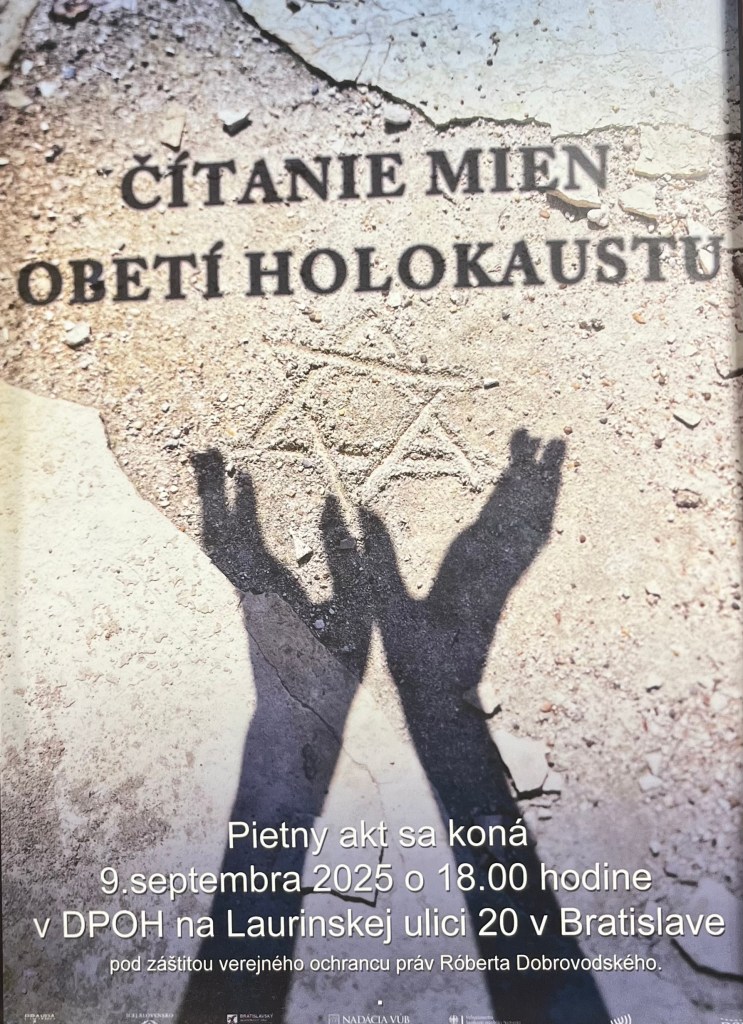
I am standing in the darkened wings backstage. I am in group 2, waiting to walk out onto the stage and read seven names. I am holding my glasses, but when I get to the lectern, the names are in such large type that I don’t need them. I read out, ‘Leopold Kohn, 67 years old, Ernestine Kohnova, 66 years old, Ignacz Kardoš, 60 years old…’ There are four more names, people I don’t know and maybe who have no one left to read the names for them. Then I turn, bow to the screen where an endless roll call of names continues to scroll and go back into the darkness backstage. 

 I am in a theatre in Bratislava and have just read out the names of my grandparents and of a great uncle. The date is September 9, 2025, 85 years to the day after the Slovak National government introduced the Jewish Codex. It was the law that defined what a Jew was and that excluded them from nearly every aspect of society. It was the law that prevented them from marrying non-Jews, from owning businesses and property, from taking part in the professions, from attending school, from owning a bicycle or a radio… It was the law that would lead to the Slovak government deporting its Jews, handing them over to the Nazis at the Polish border and paying them 500 Reichsmarks for every Jew they took. 

 After the reading, I return to my seat in the auditorium. The ceremony lasts two and a half hours and throughout, there is a never-ending scroll of names on the rear wall. After forty-five minutes, we are still on the letter B and by the end have not finished the letter M. When we get to the letter K, the whole wall is filled with the name Kohn. For most of my life I have lived in places where I am the only person with the name Kohn. On this wall, hundreds share my name. The reading of names is punctuated by music and some panel interviews. There are many different readers, but only three of us are reading the names of our relatives, the other readers are politicians, actors, journalists, priests, ambassadors … Towards the end I am interviewed about my family, alongside Vivianne, who has also travelled from England to read the names of her family. I explain that I am wearing my grandmother’s bracelet, the one she was given when she first emigrated to America and then gave to her sister, Hetty, when she returned to Slovakia in 1910.1 
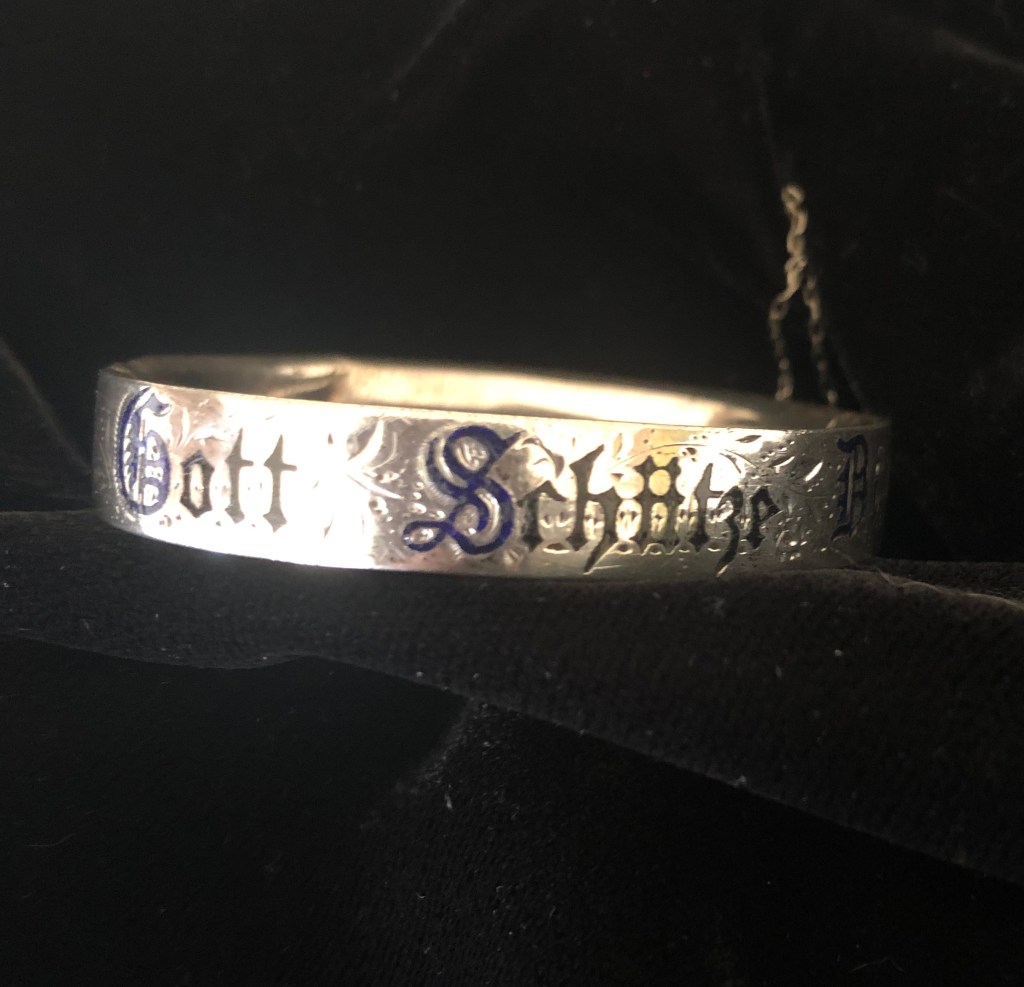
 A hundred and thirty years since that bracelet left Slovakia, it has returned. I wore it as I read her name, Ernestine. She, like millions of others, was treated as less than human. But now I had been given the opportunity to read out her name in her own country and for her to be remembered, for the crime that was committed against her to be acknowledged. The other name that I chose to read out was that of Ignacz Kardoš (known as Imre to the family). He was Erwin’s (my father’s) paternal uncle and had paid for his education because Erwin’s parents could not afford to. At the end of the war, as a member of the US army, Erwin was at the liberation of Buchenwald, and he found Imre there and helped to return him to Bratislava. He survived for just a few weeks. I had never heard of him before I began my research, but he had given my father the greatest gift- education- and I wanted to honour him. 

 The penultimate event of the evening was the presentation of an essay prize to school students. Two of the winning students were from Žilina, my father’s hometown and, after the ceremony, I congratulated them and explained my father had been at  school there over a hundred years earlier. He graduated in 1918 and went to study medicine in Prague. One of the students said she too wanted to study medicine, and I wished her luck. The circularity of the coincidence seemed appropriate. 

The final event was the lighting of candles in the shape of a star of David. Many photographs were taken and then a woman came up to me and wanted to shake my hand. She thanked me for coming and said she had always been ashamed of her country’s behaviour in the war and was grateful to me for coming back. I had felt it was my honour, but I came to realise it was also important to many Slovaks to see the descendants returning and reconnecting with the past. It made me see both the ceremony and my relationship with Slovakia differently. It was as important for the Slovaks as for those of us returning.

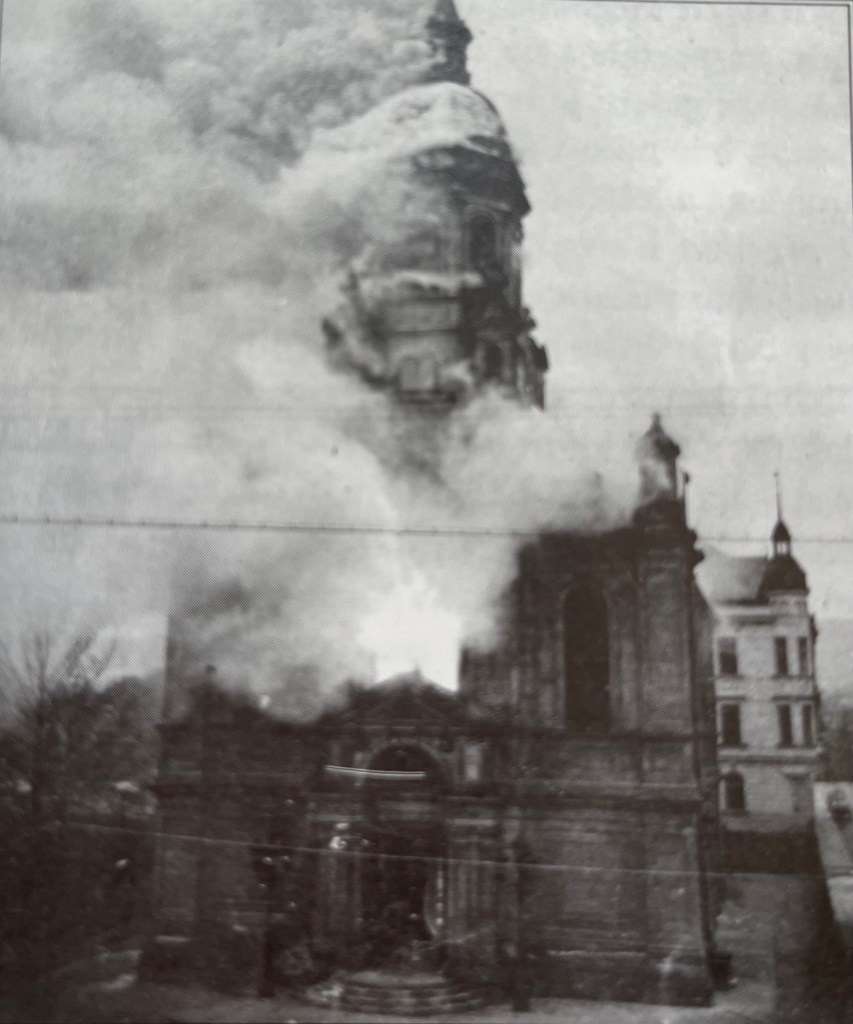
I have had an ambivalent relationship with Slovakia. My first visit, in 2018, was for the reunion of survivors of Žilina’s Jews. Then too, I was grateful for the opportunity and for the care taken by the town to recognise its past, however, I was struck by the lack of knowledge or interest in the small memorials that had been placed in memory of the deportations. In Bratislava, it took me a while to find the memorial to the victims of the Holocaust and I still cannot quite get over the ‘Underpass of Memory’, or in Slovak Podchod Pamäti. In 1964, a large dual carriageway was built leading to a new bridge over the Danube. It drove straight through the Jewish quarter and was made possible by razing the city’s synagogue to the ground. A few posters stuck to the wall in the road’s underpass explain what happened and on a small square next to the underpass is an abstract sculpture with the word ‘Remember’ on the plinth in Slovak and Hebrew. Nowhere does it explain what needs to be remembered. Nowhere does it explain that the Slovaks deported their Jews.

 On this visit, a few weeks ago, I was passing the memorial, when a large group of English-speaking tourists arrived with their guide. I stopped to listen, and was encouraged to hear her describe what had happened, and say it was a dark page in Slovakia’s history. She acknowledged that there are still Slovak historians who try to overlook or deny what took place. At the end, I went up to her and thanked her for her honesty and explained why I was there, we shook hands.

Slovakia may once again have a far-right government, whose president attended the summit in China alongside Putin and Kim Jong Un, but many of its citizens do understand the  country’s past crimes and work for a better future. The Reading of the Names is in its sixteenth year, initiated and organised by Ľuba Lesna, whose play about Tiso, Hitler’s President, is still playing to full houses in Bratislava. And then there was the young English teacher, who made a seven-hour train journey from the easternmost part of Slovakia to translate at the ceremony and was making the same journey back the next day before a full day of teaching. 

I had thought the ceremony would provide a sense of closure, but I think it was a beginning rather than an ending. It opened a door into new connections and relationships that I hope, over time, will grow.

  1. https://lookingforalice.com/2022/01/27/circle-of-remembrance/ ↩︎

Two Czechoslovakias

In Liberec there is a stunning new library. Its huge atrium is filled with light from the enormous plate-glass walls. There is a welcome desk and a café at the entrance and a wide, open-tread staircase leading up to the library itself. Protruding into the vast entrance hall is a triangular wedge of dark grey stone walls, engraved with Hebrew lettering. The library has been built on the site of Liberec synagogue that was blown up in 1938 when the Germans occupied the Sudetenland. 

The two grey walls are part of a small modern synagogue accessed from beside the library entrance. The first time we tried to visit, it was locked. The sign on the door said it was open from 9-12 every week-day morning. We returned one morning; it was still locked. I went to the library information desk and asked about it and whether it would be opened. I was told the synagogue was nothing to do with the library. Yet it was. Surely the architect had intended the presence of the synagogue to be a constant reminder to the citizens of Liberec.  The site of their new library had originally belonged to the Jewish community. Why design two huge jutting walls into the very centre of the library, if not as a reminder of that?

Yet it seems that it is easy for the present citizens of Liberec to overlook these reminders. 

I was in the Czech Republic, travelling beyond Prague to get to know more of the country and the countryside, but also to visit places connected to the story of Alice and of my father. Each time I go, I am closer to and further away from touching the world they inhabited – Czechoslovakia. That country is no more. It exists only as a historical fact, a state that was formed in 1918 and dissolved in 1992, when Czechia and Slovakia became two countries. Present day Czechs and Slovaks do not think of themselves as Czechoslovaks and if someone in Czechia asks me why I speak Czech and I say my father came from Žilina, their response is, “Oh, he was Slovak.” No, he wasn’t, he was Czechoslovak. 

Czechoslovakia may have been consigned to the past by the Czechs and Slovaks who live in that former country, but some of us are still searching for it. We do not inhabit or belong to the new reality. In the memories of those who were forced to leave and in the imagination of those who were never there, yet are still connected through family and history, Czechoslovakia lives on. Linking across the globe from Canada and the US to Britain and Poland, Israel and Switzerland, the descendants of those who left are repairing ruptured links and revisiting the world that was lost. We are gathering the threads of memory and evidence to weave into a tapestry of the past, seeking to recreate the world we never knew.

This was brought home to me while I was there, when I received two emails from strangers within days of each other. The first was from the son of Vojtech Schlesinger, the lawyer in whose office Alice worked when she first moved to Žilina with Erwin and, I discovered, was the owner of the apartment and consulting rooms that they rented. The second was from the daughter of someone who had been in Auschwitz with Dora, Alice’s friend and co-defendant. This has happened so many times now, that emails from strangers reveal the connections between us, the close links and friendships of our parents. We are so pleased to have yet another strand to add, more information to be shared and an ever-expanding understanding of the world they inhabited in that small country which they had loved and been forced to leave.   

When we visit the lands that once were part of Czechoslovakia, we search for what was lost, the buildings where our parents lived, worked, studied. Some remain, some have sunk into disrepair, others have been transformed or replaced. The new Liberec library with its small synagogue intruding into the atrium seems to be an effort to reconcile past and present. But so much of the past is absent. A few stumbling stones (stolpersteine) can be found, little brass squares with the names of those who emigrated or were killed, and I always stop and read them. They were not my relatives, but I hope somewhere some descendants of those lost families are forging new lives. 

There are four stolpersteine outside Villa Tugendhat, which we visited in Brno. The stunning villa designed by Mies van de Rohe is now a tourist attraction, but the family for whom it was built fled from the Nazis. I was expecting the guide to explain a little about the persecution Jewish families faced, but it was hardly mentioned, just in passing that they had emigrated because of the Nazi Protectorate. I thought too the guide might mention that the family’s textile factory was the one Schindler had used to save 1,200 Jews. But, no. There was an exhibition of pictures about the Schindler factory, but it was not drawn to our attention.

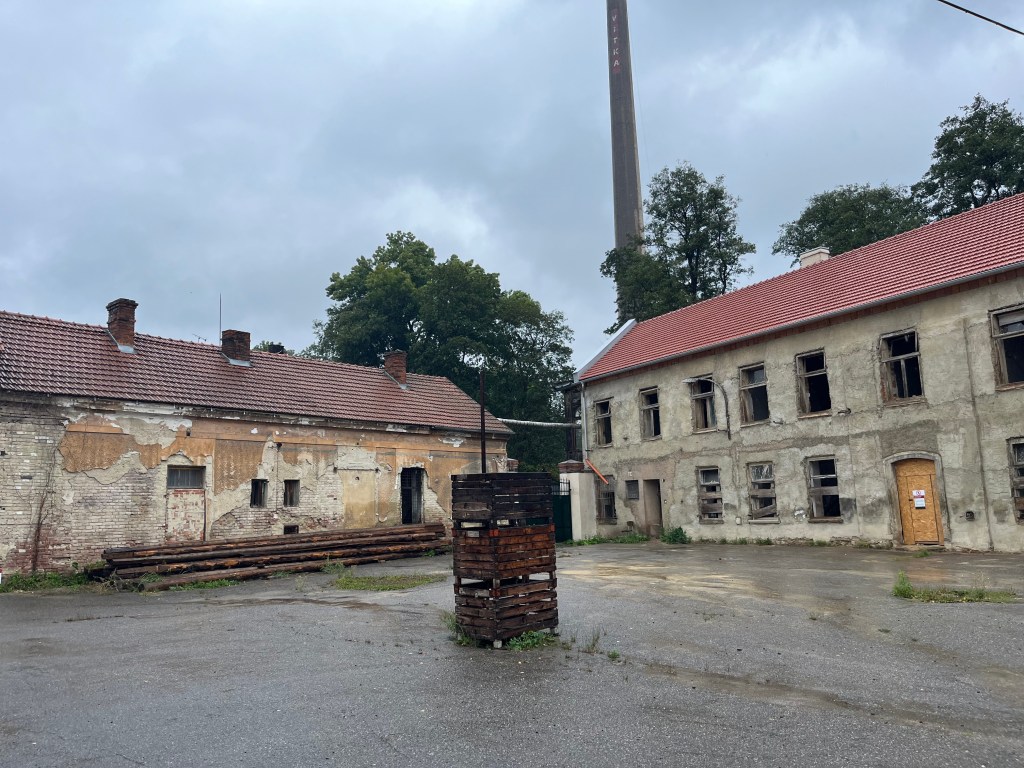
Later in the trip, we decided to try and find the Schindler factory, that had belonged to the Low-Beer family, for whose daughter Villa Tugendhat had been built. It was not easy to find, but eventually, having asked several people in the small town of Brnenec, we found it, deserted and almost derelict. It was a wet and cold day which intensified our sense of the desperate history that had been played out there. The real Czech Republic still bears the scars of its history, but those who live there today are just getting on with their lives, the past is in the past. For those, like me, who are searching for signs of that past, there are two countries, the one I am visiting as a tourist and the one in my imagination that I am trying to envisage and understand. 

Many of those living in Czechia and Slovakia have their own tortured pasts, but they have survived into the new reality. Their focus is on the lives they lead now, and the younger generation can hardly remember the hardships of the Communist past. Only the very old remember the war, it is history, but history is written by people and they choose which history to tell. Visiting the Modern Art Museum in the Veletržní palác, I was once again struck by what was absent. So many of the artists and patrons of the arts had been Jewish. Their possessions, including their art works were confiscated, why was this never mentioned? Why, when discussing the ‘the period’s multi-layered and internally conflicted art scene.’ Is there no mention of the ethnic and national diversity within Czechoslovakia? And why, in the epilogue to the exhibition, was the fact that, ‘Czechoslovakia sheltered approximately 10,000 officially registered refugees from Germany and Austria’, many of whom were artists, writers and intellectuals, foregrounded, yet there was no mention of the thousands of Jews deported and murdered from Czechoslovakia later in the war? I find myself searching for a recognition of the contribution our ancestors made to what was Czechoslovakia.

There are memorials, most recently the naming of a street in Prague after Nicholas Winton, but they are gestures. The history of the Jews of Czechoslovakia is not integrated into the history of Czechoslovakia, it is somehow separate, still in a metaphorical ghetto. It is in a locked synagogue that juts into Liberec library but that the citizens of Liberec ignore. 

It seems that there are two Czechoslovakias, one consigned to history, the other being recreated fragment by fragment through the memories and imagination of the descendants of those forced to leave. I was going to distinguish between the two as one real and the other metaphorical, but in a way, neither ever existed in the material world. Nation is a concept and there are at least two concepts of Czechoslovakia, one which includes the Jews and one which ignores them. 

Quotations from the displays in the Modern Art Museum in the Veletržní palác.